
Sioux County Court Records After Arrest
Sioux County court records after arrest should be read as the court side of the same event that first appears in jail records. The Sioux County arrest press log can show the arresting agency, arrest location, code or charge description, incident number, warrant number, bond amount, bond type, release date, and release reason. The current jail roster is narrower. It lists current inmates with date booked, name, reason booked, and charge lines. Neither source is the final court disposition.
The formal court record starts when a complaint, trial information, indictment, warrant filing, or later court entry is made in the Iowa court system. Sioux County is in Iowa Judicial District 3, and official case lookup runs through Iowa Courts Online. Custody and booking details belong with Sioux County jail inmate records, while booking-photo questions belong with Sioux County jail roster mugshots. The court case is where charges are filed, changed, dismissed, resolved, or used for sentencing.
In Iowa, the County Attorney is the local prosecutor. The Sioux County Attorney page identifies Thomas Kunstle as County Attorney and says the office's primary duty is criminal prosecution. It also says prosecuting decisions, except for simple misdemeanors, rest with the County Attorney. That matters because jail charges are arrest-level allegations, while the prosecutor's filings create the charge set that appears in court records after the arrest.
Find Sioux County Court Records
The best starting point for court records after a Sioux County jail arrest is the official court portal, then the local court directory if certified copies or clerk help are needed. The Iowa Judicial Branch Sioux County District Court page is the county court entry, and Iowa Courts Online is the statewide electronic docket index. If the arrest log shows a case or warrant number with prefixes such as AGCR, SRCR, FECR, OWCR, SMSM, or LACV, use that number to narrow the search.
- Start with the Sioux County arrest log or current roster and copy the name spelling, arrest date, charge text, incident number, and warrant number if shown.
- Open Iowa Courts Online and enter the portal from the official search page.
- Search by defendant or party name. If the arrest log shows a court or warrant number, try that number too.
- Use Sioux County as the county filter when the portal offers one, then compare dates and charge text before assuming a match.
- Open the docket index and read each charge, hearing entry, bond entry, warrant entry, amendment, dismissal, plea, judgment, or sentencing line.
The Iowa Courts Online entry page uses frames and dynamic screens, so the research capture could not confirm every live field. The usable field set for a Sioux County court records search is still clear enough for most users: name, case number, county, and case type. Expanded access, payments, or registration should follow the instructions shown inside the court portal.
| Search Field | How to Use It | Sioux County Notes |
|---|---|---|
| Defendant or party name | Search the name from the jail roster or arrest log. | Roster and warrant names are often in uppercase LAST,FIRST format, so try surname first. |
| Case number | Use a known warrant or case number to narrow results. | Arrest and warrant PDFs may show prefixes such as FECR, SRCR, AGCR, OWCR, SMSM, or LACV. |
| County | Select Sioux County when the portal offers county filtering. | This helps separate common names from nearby county cases. |
| Case type | Filter by criminal, simple misdemeanor, traffic, or civil where available. | The arrest source may not tell the final case type, so check more than one path when needed. |
| Portal action | Follow the portal's search, docket, registration, and payment prompts. | Static research reached the entry page but not every dynamic action screen. |
Charging Records After Jail Arrest
A Sioux County arrest can be based on a new law-enforcement encounter, an active warrant, a court order, or a hold for another agency. Booking happens at the Sioux County Jail, but the court record turns on the charging document and later docket entries. The arrest log may be the first source to show a code, charge description, bond amount, and warrant number. Iowa Courts Online is the source to check for the filed charge and the later case history.
Charging documents are not all the same. A complaint is often the early document that starts a case or supports an arrest. A trial information is a prosecutor-filed document used in many Iowa indictable cases. An indictment is a grand-jury charge. The document used affects how the case appears, but all three can create court records after a jail arrest.
| Document | Who Files It | What It Does | Why It Matters |
|---|---|---|---|
| Complaint | Officer or prosecutor | States the alleged offense and facts used to start the case. | Often links the arrest or warrant to the first court entry. |
| Trial information | County Attorney | Formally charges many Iowa indictable offenses without a grand jury. | May differ from the booking charge after prosecutor review. |
| Indictment | Grand jury | Charges an offense after grand-jury action. | Less routine, but still creates the charge record in court. |
The Sioux County Attorney page states that a jury or court cannot convict a person of an indictable crime unless the County Attorney first decides that pursuing the charge serves justice. That statement is a useful guardrail for readers. The jail record says why the person was held. The court record says what the State chose to file and what the court did with it.
Sioux County Charge Status Records
Charge status is the part of court records after an arrest that most often changes. A roster charge may be short or abbreviated. The arrest log may show richer charge and bond fields. The court docket can then show that a count is pending, amended, reduced, dismissed, deferred, or resolved by conviction. Do not treat the first booking charge as the final outcome.
| Status | Plain Meaning | Where to Check |
|---|---|---|
| Pending | The charge has been filed and has not reached a final result. | Iowa Courts Online docket entries and hearing calendar. |
| Amended | The filed charge changed by prosecutor or court filing. | Later docket entries and charging documents. |
| Reduced | A lesser charge replaced or resolved the original charge. | Plea, judgment, or amended filing entries. |
| Dismissed | The count or case ended without conviction on that charge. | Dismissal or order entries in the court docket. |
| Deferred judgment | A non-conviction result may follow if required terms are completed. | Court docket and Iowa DCI release rules. |
| Conviction | A guilty plea, verdict, or adjudication produced a final criminal result. | Judgment, sentence, and criminal-history records. |
For an official statewide criminal-history record, use the Iowa Division of Criminal Investigation rather than the sheriff's local jail check. The DCI criminal-history process requires at least first name, last name, and exact date of birth. The research notes a $15 fee per last name and online, mail, fax, email, and in-person request channels. Phone requests are not accepted. Processing is often one to three days, while the FAQ says mail, fax, or email requests are generally handled in two to five business days after receipt.
Bond Records After Arrest
Bond information in Sioux County can appear before a full court search is complete. The arrest press log has fields for Bond Amount and Bond Type, plus release reasons. Research found local labels such as PERSONAL RECOG, CASH, CASH OR SURETY, UNSECURED, BOND AMOUNT 0, and APPEAL. It also found release reasons including REL ON RECOG, CASHBONDPOSTED, BONDSMAN, UNSECURED BOND, ORDER OF COURT, SERVED TIME, and RELEASED-ICE.
Iowa Code chapter 811 is the state bail and release chapter. It gives the legal framework, but the public Sioux County sources do not publish a dedicated bond payment page, online bond portal, accepted payment list, bond counter schedule, or approved bonding-company list. Verify current terms with the jail or court before attempting payment. A release reason of ORDER OF COURT means a court order controlled release. RELEASED-ICE means an immigration custody path, not ordinary release into the community.
| Bond or Release Label | What It Usually Signals | Extra Check |
|---|---|---|
| Personal recognizance | Release based on a promise to appear and obey conditions. | Read court conditions before assuming no restrictions apply. |
| Cash | Cash payment is required for release unless a court changes the order. | Call the jail or Clerk of Court for current payment rules. |
| Cash or surety | Cash or surety bond may satisfy the bond order. | Confirm the amount and any separate hold. |
| Unsecured | No full upfront payment may be due unless release terms are broken. | Check the docket for release conditions. |
| Federal, ICE, or other-agency hold | Another agency may control custody even if local bond is posted. | Use ICE ODLS, BOP, the jail, or the other agency as appropriate. |
Warrant Court Records After Arrest
Warrants are a common bridge between jail custody and court records after a Sioux County arrest. The Sheriff's Office publishes an active warrant PDF that can be searched in a browser or PDF viewer by name, warrant number, or charge. The warrant list can show warrant number, issue date, name, date of birth, physical descriptors, charge, bond amount, and disposition code. It is separate from the arrest log. A person may appear on the warrant list before arrest and then appear in the arrest log or roster after the warrant is served.
The warrant route needs care. Iowa Code section 804.29 makes warrant-supporting information filed with the court confidential until arrest, return, or initial appearance unless a court orders otherwise. The public warrant list may tell enough to locate the person or case number, but it may not show the full affidavit or court reason behind the warrant. Bench warrants may come from failures to appear, probation matters, fine or cost issues, no-contact order cases, and other court events. Iowa Courts Online is the better source for the case entry behind a warrant.
Note: A warrant list is not legal advice. Verify status with the court, jail, or counsel before acting on a warrant entry.
Charges vs Convictions Records
An arrest charge and a conviction are different legal events. The Sioux County arrest log itself includes a presumption-of-innocence notice. That point should carry through every court records search after an arrest. A charge is an accusation or filed count. A conviction is a final result after a guilty plea, verdict, or other adjudication. Some charges are changed. Some are dismissed. Some end in deferred judgment or other outcomes that can affect DCI release rules.
| Question | Charge | Conviction |
|---|---|---|
| What is it? | An allegation listed by law enforcement, prosecutor, or court filing. | A final finding or plea that resolves guilt on a charge. |
| Where first seen? | Arrest log, jail roster, complaint, trial information, or indictment. | Judgment, sentence, criminal-history result, or final docket entry. |
| Can it change? | Yes. Charges may be amended, reduced, added, or dismissed. | Less often. Later relief may affect visibility or record release. |
| How to verify? | Compare jail records with Iowa Courts Online. | Use Iowa Courts Online, Clerk of Court records, or Iowa DCI. |
Sealed vs Expunged Records
Sealing and expungement are often confused, and Sioux County court records after arrest should not be described as cleared unless an official record says so. A sealed record is restricted from ordinary public view. An expunged record is removed or treated differently under the law. Iowa record relief depends on the case type, disposition, waiting period, and court order. The local jail public-information check does not provide dispositions, so it cannot answer whether a case qualifies for relief.
| Point | Sealed | Expunged |
|---|---|---|
| Public visibility | Hidden or restricted from ordinary public access. | Removed or treated as no longer publicly available under the applicable order. |
| Who may still see it? | Courts or law enforcement may retain limited access depending on law. | Access is more limited, but the exact effect depends on Iowa law and the order. |
| How it happens | Usually by court rule, statute, or judge's order. | Usually by eligibility, filing, and a court order. |
| What to check | Iowa Courts Online and Clerk of Court records. | Court orders, DCI release limits, and legal counsel when needed. |
DCI release limits also matter. The research notes that without a signed release, completed deferred judgments to non-law-enforcement agencies and arrests older than 18 months without final disposition cannot be released. Most juvenile records are confidential and not included. For a person trying to understand whether an arrest still appears on a record check, DCI and the Clerk of Court are more reliable than a jail roster.
Sioux County Records Routing
Different offices answer different questions after a jail arrest. The Sioux County Sheriff's local jail public-information check requires full name and date of birth for the subject plus a government photo ID from the requester. It returns only date of arrest, arresting agency, and charges for people brought to Sioux County Jail. It does not include the court disposition, juvenile records, traffic records, or records from other agencies. Requests can be made in person, by mail, by phone with payment sent separately, or by email with payment mailed separately.
The County Attorney is not a private legal advice office and does not represent individuals. Its page says it prosecutes crimes, advises law enforcement, handles other state and county legal duties, and does not investigate crimes for private people. For court records after an arrest, use the court portal or Clerk of Court. For custody status, use the jail roster, jail phone, or sheriff app. For state prison custody after sentencing, use Iowa DOC Offender Search. For federal prison custody, use BOP Inmate Locator. For immigration detention, use ICE ODLS and the ICE Sioux County Jail facility page. Iowa VINELink is available for custody and case notifications.
The image below comes from the Iowa Courts Online portal entry, the official statewide path for electronic docket lookup.
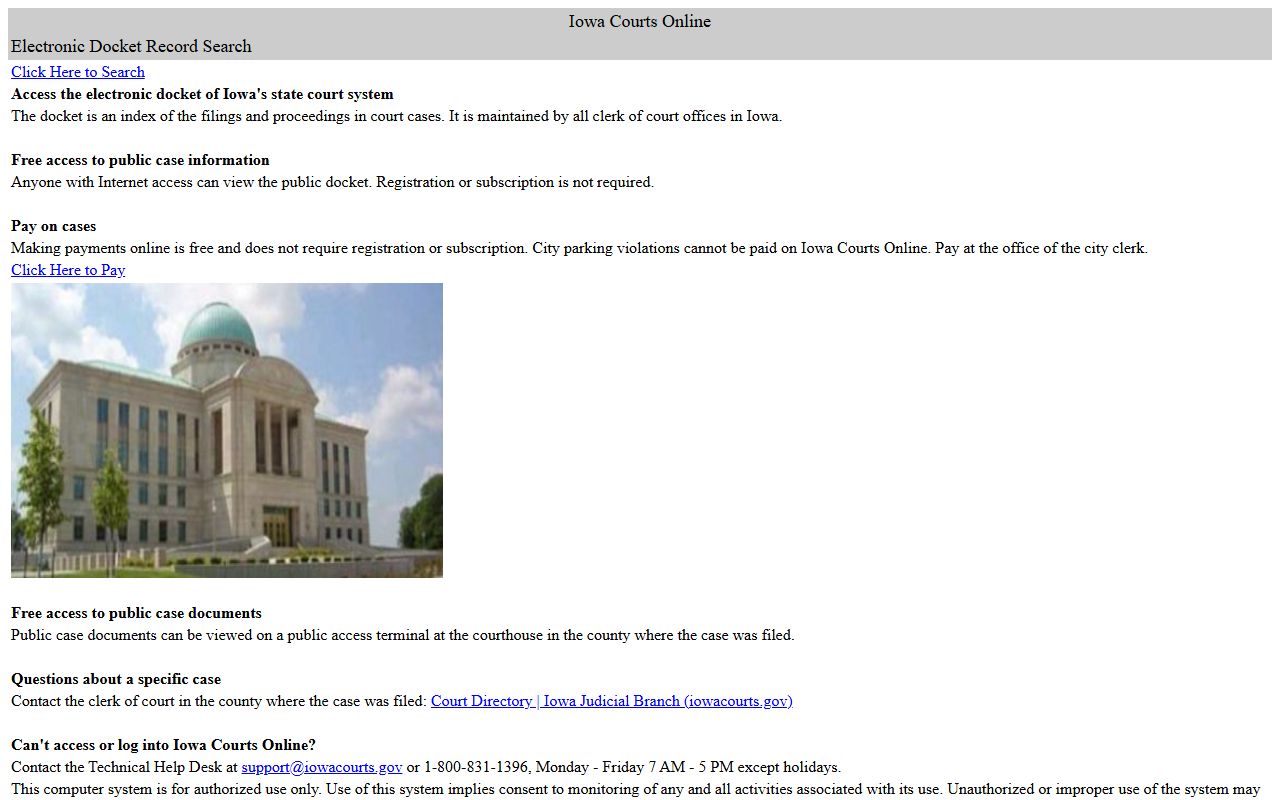
Use the portal for filed court records, then use the sheriff's jail records only to confirm the custody layer of the same arrest.
Restricted Court Records After Arrest
Not every record tied to a Sioux County arrest is fully public. Iowa Code chapter 22 governs public records, but specific exemptions still apply. The sheriff's public-records page lists confidential categories such as peace officer investigative narratives beyond the immediate facts, social security numbers, dates of birth, driver's license information, Chapter 692 intelligence data, registered victim information, child-victim identities, witness or reporting-caller information, psychological exam results, confidential informant information, and mental or health information. Active investigations may also limit what is released.
That does not mean there is no public record. It means the correct record source matters. Court records may show the filed charge and case action. Sheriff jail checks may show only arrest date, arresting agency, and charges. DCI may withhold certain old arrests without final disposition when no signed release is provided. Juvenile material is usually treated differently. When a record is missing from one system, check whether it belongs in another system before assuming it does not exist.
Important: This site is not a consumer reporting agency and court or jail information must not be used for FCRA-covered screening decisions.